 2019, Vol. 28


2 浙江省人民医院,杭州医学院附属人民医院麻醉科 310014;
3 中山大学附属第一医院急诊科, 广州 510080
2 Department of Anesthesiology, Zhejiang Provincial People's Hospital, People's Hospital of Hangzhou Medical College, Hangzhou 310014, China;
3 Emergency Department, the First Affiliated Hospital of Sun Yat-sun University, Guangzhou 510080, China
随着心肺复苏技术的普及与发展,心脏骤停(cardiac arrest, CA)患者的自主循环恢复(restoration of spontaneous circulation, ROSC)率明显提高,但在大多数国家和地区患者出院存活率仍不足10%[1],复苏后脑损伤是CA患者死亡及致残的重要原因[2]。尽管复苏后脑损伤在CA患者中普遍发生且后果严重,但对其治疗手段相对匮乏。
七氟醚(sevoflurane)是临床常用麻醉药物,对缺血脏器也有较强的保护作用[3-4]。近年来有研究者将七氟醚应用于心肺复苏领域,发现其可以减轻CA造成的脑损伤[5-6]。另外,临床上亚低温是用于减轻心脏骤停脑损伤的常规治疗,而七氟醚可以用于亚低温实施过程中的镇静镇痛,以预防应激、寒颤[7],所以七氟醚在心肺复苏领域应用前景广阔。本研究拟探讨七氟醚减轻复苏后脑损伤的机制,为将来进一步临床转化使用提供理论基础。
1 材料与方法 1.1 动物准备及大鼠CA模型的建立本实验获中山大学动物伦理委员会批准,40只成年雄性wistar大鼠,体质量300~350 g,由中山大学实验动物中心提供。动物购进后于SPF级动物房饲养一周,实验前12 h禁食不禁水。动物麻醉:戊巴比妥钠(Sigma,美国)30 mg/kg腹腔内注入,酌情给予1/3首剂量维持。麻醉成功后,以14 G鞘管经口气管插管固定,接小动物呼吸机(Harvard Apparatus,美国),通气频率70次/min,潮气量12 mL/kg。连续Ⅱ导联心电监护。解剖分离股动静脉,24 G留置针穿刺置管,动脉管监测动脉血压,静脉管用以给药。4通道生理信号采集分析系统(SantaBarbara,美国)记录心电信息。调整电热毯温度使肛温维持在(36.5±0.5)℃。采用经皮电刺激心外膜诱发室颤法建立大鼠CA模型,室颤持续6 min后开始CPR,按压频率200次/min,按压深度为胸廓前后径1/3,同时开始机械通气参数设置同前。2 min后进行除颤,每3 min予20 µg/kg肾上腺素静推,如此反复直至ROSC。ROSC定义为平均动脉压(mean arterial pressure,MAP) > 60 mmHg(1 mmHg=0.133 kPa)并持续10 min以上,复苏10 min无效者宣布复苏失败。
1.2 实验分组随机数字法将大鼠随机分为3组,分别是假手术组(Sham, n=8)、七氟醚组(Sevo, n=16)及对照组(Control, n=16)。Sham组仅进行手术操作,不诱发室颤及心肺复苏;Sevo组在ROSC后立即给予2.4%七氟醚吸入10 min;Control组进行常规CPR。
1.3 术后监测与取材术后监测并机械通气至ROSC 3 h,动物拔管回笼。各组分别于ROSC 24 h随机安乐死(过量麻醉后断头)5只大鼠并取大脑皮层,按说明书(百泰克全蛋白提取试剂盒, 北京)提取全蛋白用于Western blot检测;按说明书(普利莱线粒体提取试剂盒,北京)提取线粒体用于线粒体功能检测,胞质提取液用于细胞色素c检测;各组剩余大鼠于ROSC 72 h安乐死并取大脑进行石蜡切片用于后续TUNEL检测。
1.4 Western blot方法检测大脑皮质细胞凋亡相关蛋白的表达取40 µg蛋白进行聚丙烯酰胺凝胶电泳,湿转法转移蛋白到PVDF膜,5%的脱脂奶粉封闭2 h,Ⅰ抗(1:1 000)4 ℃过夜,TBST液洗膜,每次10 min,共3次,滴加Ⅱ抗(1:5 000)室温下孵育1 h,TBST液洗膜10 min 3次,Millipore发光液浸泡1 min,凝胶成像仪曝光成像(Image Quant LAS4000mini,美国)。一抗:Bax、Bak、Bcl-2、细胞色素c、caspase 9、caspase 3均购自CST,β-actin购自Abgent; 二抗购自Abgent。
1.5 线粒体通透转换孔开放程度的测定采用分光光度计法,以线粒体于540 nm处吸光度下降程度间接反映线粒体通透转换孔(mitochondrial permeability transition pore, MPTP)开放程度[8]。大脑皮质线粒体加入测定介质(125 mmol/L蔗糖, 50 mmol/L KCl, 2 mmol/L KH2PO4, 10 mmol/L HEPES)内调整浓度(0.5 mg/mL)制备线粒体反应体系,加入氯化钙(200 µmol/L)诱发线粒体肿胀,每分钟记录吸光度值直至吸光度不再减少(约10 min)。
1.6 线粒体膜电位测定采用JC-1探针(碧云天线粒体膜电位检测试剂盒,中国),荧光酶标仪(BioTek,美国)检测线粒体膜电位(mitochondrial membrane potential, MMP)。在线粒体膜电位高时,JC-1聚集在线粒体的基质中形成聚合物,产生红色荧光,而在线粒体膜电位低时JC-1不能聚集,此时JC-1为单体,产生绿色荧光。详细步骤按试剂盒说明进行,以红绿荧光的相对比例来反映线粒体膜电位高低。
1.7 TUNEL检测神经元凋亡凋亡试剂盒购自Roche。TUNEL检测神经元凋亡,具体步骤见参考文献[9]。制备好的切片在IX71型倒置荧光显微镜(Olympus,日本)下观察,计数海马CA1区凋亡神经元,计算凋亡指数。
1.8 统计学方法采用SPSS13.0软件进行统计分析,计量资料以均数±标准差(Mean±SD)表示,并进行正态性检验。参数的多组间比较采用单因素方差分析,多样本均数间的两两比较采用LSD-t检验,以P < 0.05为差异具有统计学意义。
2 结果 2.1 基本生理参数及复苏指标各组动物体质量、心率、MAP基线值比较差异无统计学意义(均P > 0.05),见表 1;各组动物CPR时间、除颤次数、肾上腺素用量及ROSC率的比较差异无统计学意义(均P > 0.05)。Sevo组有2只、Control组有5只动物未存活至预定时间点。
| 指标 | Sham组(n=8) | Sevo组(n=16) | Control组(n=16) |
| 体质量(g) | 323±15 | 328±15 | 331±14 |
| 心率(次/min) | 410±21 | 404±18 | 406±19 |
| MAP(mmHg) | 94±13 | 91±12 | 90±12 |
| CPR时间(s) | - | 290±163 | 257±148 |
| 除颤次数(次) | - | 2±1 | 2±1 |
| 肾上腺素(μg) | - | 14±6 | 13±6 |
| ROSC率 | - | 13/16 | 14/16 |
| 24 h存活(只) | 8 | 12 | 12 |
| 24 h取材(只) | 5 | 5 | 5 |
| 72 h存活(只) | 3 | 6 | 4 |
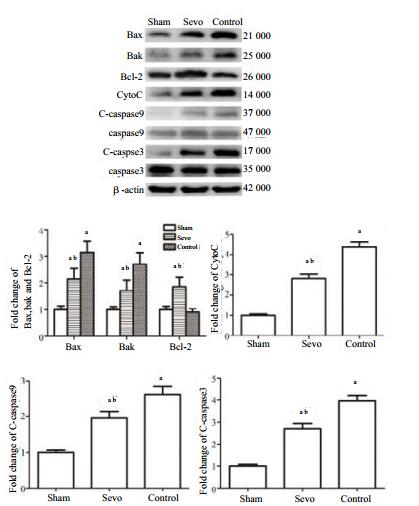
Sevo组与Control组大鼠大脑皮层Bax、Bak、裂解Caspase 9、裂解caspase 3表达和胞质中细胞色素c含量均显著高于Sham组(均P < 0.05),见图 1;但Sevo组上述蛋白表达均显著低于Control组(均P < 0.05);Sevo组Bcl-2表达较Sham组及Control组均增高(P < 0.05)。
|
| 与Sham组比较,aP < 0.05;与Control组比较,bP < 0.05;n=5 图 1 凋亡相关蛋白的表达 Fig 1 The expression of apoptotic proteins |
|
|
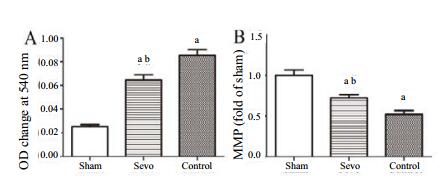
加入氯化钙诱导下Sevo组及Control组线粒体吸光度下降均较Sham组显著(均P < 0.05),见图 2A;但Sevo组下降值小于Control组(P < 0.05)。
|
| A:MPTP开放程度的比较;B:MMP的比较;与Sham组比较,aP < 0.05;与Control组比较,bP < 0.05;n=5 图 2 各组大鼠间MPTP开放程度及MMP的比较 Fig 2 Comparison of MPTP and MMP in the three groups |
|
|
Sevo组及Control组线粒体膜电位均较Sham组下降(均P < 0.05),见图 2B;但Sevo组膜电位高于Control组(P < 0.05)。
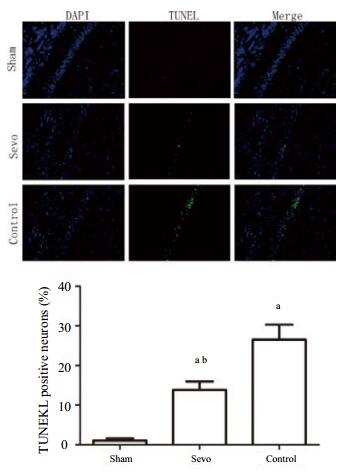
2.4 各组神经元凋亡的比较TUNEL检测显示,Sevo组(14%)与Control组(26%)大鼠大脑CA1区神经元凋亡指数均显著高于Sham组(1%,均P < 0.05),见图 3;但Sevo组大鼠大脑CA1区神经元凋亡指数显著低于Control组(P < 0.05)。
|
| 与Sham组比较,aP < 0.05;与Control组比较,bP < 0.05; n=3 (Sham),6 (Sevo),4 (Control) 图 3 ROSC 72 h神经元凋亡情况(×200) Fig 3 Neuronal apoptosis in the three groups at 72 h after ROSC (×200) |
|
|
ROSC后存活神经元减少是复苏后神经功能障碍的重要原因[10]。凋亡(apoptosis)和坏死(necrosis)是缺血-再灌注细胞死亡的主要形式[11],而线粒体在细胞死亡过程中起重要作用[12]。细胞凋亡与线粒体外膜通透及随后的细胞色素c释放诱发的线粒体凋亡途径相关[13],细胞坏死与MPTP开放导致的线粒体肿胀、破裂相关[14]。而Bax和Bak在线粒体外膜通透及MPTP的开放过程中均起重要作用[15]。
Bcl-2家族蛋白是细胞凋亡的关键调控者,主要作用部位是线粒体外膜[16]。当细胞受到凋亡刺激后,胞质中的凋亡前体蛋白Bax移位至线粒体外膜与外膜上的Bak形成聚合体,使线粒体外膜孔道形成,膜间质内的细胞色素c释放,激活凋亡效应器caspase,诱发凋亡[17]。抗凋亡蛋白Bcl-2则促使易位到线粒体外膜的Bax重回细胞质、阻止线粒体外膜通透[18]。本研究发现,七氟醚可以减少ROSC后凋亡前体蛋白Bax和Bak的过量表达,增加抗凋亡蛋白Bcl-2的表达,减少线粒体膜间质内的细胞色素c的释放,减轻下游的caspase 9及caspase 3的激活,从而减少神经元凋亡的发生。
MPTP的开放状态决定细胞生死存亡[14],但MPTP的结构组成一直存在较大争议,近年来研究发现位于线粒体外膜的Bax和Bak(而非电压依赖性阴离子通道)以及位于线粒体内膜的F1F0ATP合成酶是MPTP的核心构成部分[19]。Bax和Bak聚合使线粒体外膜通透,钙超载和活性氧(ROS)等诱导线粒体内膜孔道形成,两者共同介导了MPTP的开放。MPTP开放,膜电位随之下降、呼吸链断裂、ATP产生抑制,胞质水和离子大量进入线粒体基质,线粒体肿胀破裂,最终细胞坏死[14, 20]。Karch等[15]发现,敲除Bax和Bak可以抑制MPTP的开放,而重构了Bax和Bak的细胞会导致线粒体外膜孔道形成、MPTP开放。本研究发现,Sevo组MPTP的开放及MMP的下降程度减轻,这可能与七氟醚抑制Bak和Bax过量表达有关。
目前计数坏死细胞仍很困难,组织切片形态学观察易重复计数坏死细胞和凋亡细胞[21],故本研究未对坏死细胞进行计数。
综上所述,七氟醚可能通过下调Bax和Bak,上调Bcl-2的表达,减少细胞凋亡并抑制MPTP开放程度,从而发挥脑保护作用。目前还需要更多的研究来探索七氟醚在心肺复苏领域的应用,以期早日临床转化应用。
| [1] | Lee S, Song K, Shin S, et al. A disparity in outcomes of out-of-hospital cardiac arrest by community socioeconomic status: A ten-year observational study[J]. Resuscitation, 2018, 126: 130-136. DOI:10.1016/j.resuscitation.2018.02.025 |
| [2] | Stub D, Bernard S, Duffy S, et al. Post cardiac arrest syndrome: a review of therapeutic strategies[J]. Circulation, 2011, 123(13): 1428-1435. DOI:10.1161/CIRCULATIONAHA.110.988725 |
| [3] | 李恒杰, 魏红艳, 邓宇斌, 等. 七氟醚对心脏骤停大鼠心肌保护作用的研究[J]. 中华急诊医学杂志, 2016, 25(1): 28-32. DOI:10.3760/cma.j.issn.1671-0282.2016.01.008 |
| [4] | Ye R, Yang Q, Kong X, et al. Sevoflurane preconditioning improves mitochondrial function and long-term neurologic sequelae after transient cerebral ischemia[J]. Crit Care Med, 2012, 40(9): 2685-2693. DOI:10.1097/CCM.0b013e318258fb90 |
| [5] | Wang Z, Ye Z, Huang G, et al. Sevoflurane post-conditioning enhanced hippocampal neuron resistance to global cerebral ischemia induced by cardiac arrest in rats through PI3K/Akt survival pathway[J]. Front Cell Neurosci, 2016, 10: 271. DOI:10.3389/fncel.2016.00271 |
| [6] | Meybohm P, Gruenewald M, Zacharowski KD, et al. Mild hypothermia alone or in combination with anesthetic post-conditioning reduces expression of inflammatory cytokines in the cerebral cortex of pigs after cardiopulmonary resuscitation[J]. Crit Care, 2010, 14(1): R21. DOI:10.1186/cc8879 |
| [7] | Hellström J, Öwall A, Martling C, et al. Inhaled Isoflurane sedation during therapeutic hypothermia after cardiac arrest[J]. Crit Care Med, 2014, 42(2): e161-166. DOI:10.1097/CCM.0b013e3182a643d7 |
| [8] | Gong P, Hua R, Zhang Y, et al. Hypothermia-induced neuroprotection is associated with reduced mitochondrial membrane permeability in a swine model of cardiac arrest[J]. J Cereb Blood Flow Metab, 2013, 33(6): 928-934. DOI:10.1038/jcbfm.2013.33 |
| [9] | 魏红艳, 廖晓星, 尹美娴, 等. 亚低温促进神经元自噬减轻小鼠脑缺血-再灌注损伤[J]. 中华急诊医学杂志, 2017, 26(9): 1037-1042. DOI:10.3760/cma.j.issn.1671-0282.2017.09.012 |
| [10] | 李恒杰, 卢远征, 魏红艳, 等. 大鼠心脏骤停后脑损伤与葡萄糖代谢关系的实验研究[J]. 中华急诊医学杂志, 2018, 27(5): 502-556. DOI:10.3760/cma.j.issn.1671-0282.2018.05.009 |
| [11] | Gottlieb R. Cell death pathways in acute ischemia/reperfusion injury[J]. J Cardiovasc Pharmacol Ther, 2011, 16(3/4): 233-238. DOI:10.1177/1074248411409581 |
| [12] | Biala A, Kirshenbaum L. The interplay between cell death signaling pathways in the heart[J]. Trends Cardiovasc Med, 2014, 24(8): 325-331. DOI:10.1016/j.tcm.2014.08.002 |
| [13] | Danial N, Korsmeyer S. Cell death: critical control points[J]. Cell, 2004, 116(2): 205-219. DOI:10.1016/s0092-8674(04)00046-7 |
| [14] | Ying Y, Padanilam B J. Regulation of necrotic cell death: p53, PARP1 and cyclophilin D-overlapping pathways of regulated necrosis?[J]. Cell Mol Life Sci, 2016, 73(11/12): 2309-2324. DOI:10.1007/s00018-016-2202-5 |
| [15] | Karch J, Kwong J, Burr A, et al. Bax and Bak function as the outer membrane component of the mitochondrial permeability pore in regulating necrotic cell death in mice[J]. Elife, 2013, 2: e772. DOI:10.7554/eLife.00772 |
| [16] | Kuwana T, Mackey M, Perkins G, et al. Bid, bax, and lipids cooperate to form supramolecular openings in the outer mitochondrial membrane[J]. Cell, 2002, 111: 331-342. DOI:10.1016/s0092-8674(02)01036-x |
| [17] | Renault T, Floros K, Chipuk J. BAK/BAX activation and cytochrome c release assays using isolated mitochondria[J]. Methods, 2013, 61(2): 146-155. DOI:10.1016/j.ymeth.2013.03.030 |
| [18] | Edlich F, Banerjee S, Suzuki M, et al. Bcl-xL Retrotranslocates Bax from the mitochondria into the cytosol[J]. Cell, 2011, 145(1): 104-116. DOI:10.1016/j.cell.2011.02.034 |
| [19] | Kwong JQ, Molkentin JD. Physiological and pathological roles of the mitochondrial permeability transition pore in the heart[J]. Cell Metabolism, 2015, 21(2): 206-214. DOI:10.1016/j.cmet.2014.12.001 |
| [20] | Golstein P, Kroemer G. Cell death by necrosis: towards a molecular definition[J]. Trends Biochem Sci, 2007(32): 37-43. DOI:10.1016/j.tibs.2006.11.001 |
| [21] | Yeganeh F, Nikbakht F, Bahmanpour S, et al. Neuroprotective effects of NMDA and group I metabotropic glutamate receptor antagonists against neurodegeneration induced by homocysteine in rat hippocampus: in vivo study[J]. J Mol Neurosci, 2013, 50(3): 551-557. DOI:10.1007/s12031-013-9996-5 |