 2023, Vol. 32


急性肾损伤(acute kidney injury, AKI)是重症监护病房(intensive care unit, ICU)中常见且复杂的临床并发症。ICU中约53%的AKI是由脓毒症引起的,随后导致住院时间更长、病死率更高以及患者的经济负担更重[1-2]。尽管临床治疗有所改善,但由于多器官衰竭、微血管功能障碍和全身炎症反应综合征,脓毒症并发AKI患者的病死率仍是很高[3-5]。然而,通过及时干预和有效治疗,AKI可以在早期逆转,从而降低AKI相关病死率[6]。因此,识别AKI高危患者对于ICU环境下脓毒症患者的管理至关重要。因此,本研究将入室的危重症评分联合炎性标志物构建预测ICU脓毒症患者发生AKI的列线图,并验证其早期预测的有效性。
1 资料与方法 1.1 一般资料本研究回顾性收集2015年4月至2021年12月入住济宁医学院附属医院ICU的脓毒症患者。脓毒症诊断标准:根据Sepsis-3.0诊断标准来定义脓毒症,即确定感染基础上,序贯器官衰竭评分(sequential organ failure assessment, SOFA)≥2分[7]。AKI诊断参照改善全球肾脏预后组织的诊断标准[8]。纳入标准:(1)年龄≥18岁;(2)入院诊断为脓毒症;(3)ICU住院时间>24 h且住院病例信息完整。排除标准:(1)入院时已发生AKI;(2)有慢性肾衰竭病史;(3)实验室化验检查数据缺失值> 20%。
本研究符合医学伦理学标准,并经济宁医学院附属医院伦理委员会批准(审批号:2020C018),所有治疗和指标检测均获得过患者或家属的知情同意。
1.2 数据收集本研究收集(1)人口统计学信息:性别、年龄、身高、体重、体重指数;(2)入ICU后的第一次生命体征:体温、心率、呼吸、血压;(3)入ICU的第一次实验室化验结果:血常规、血生化、动脉血气、C反应蛋白、白介素-6、降钙素原(procalcitonin, PCT)等;(4)基础疾病:如高血压、糖尿病、冠心病、脑血管疾病等;(5)各类评分:入ICU第1天的格拉斯哥昏迷量表评分、24 h内急性生理学与慢性健康状况(acute physiology and chronic health evaluation, APACHE)-Ⅱ评分和SOFA评分。
1.3 统计学方法统计分析软件应用SPSS 23.0、EmpowerStats 4.0(易侕软件)和风锐统计学软件。计量资料符合正态分布的以均数±标准差(x±s)表示,两组间比较采用独立样本t检验;不符合正态分布的以中位数和四分位数[M(Q1,Q3)]表示,两组间比较应用Mann-Whitney U检验。计数变量以例数(%)表示,两组间比较采用卡方检验。采用Logistic回归分析探讨脓毒症患者发生AKI的影响因素。将纳入患者按照7∶3的比例随机分为训练集和验证集。根据多因素Logistic回归分析结果构建列线图模型。通过受试者工作特征曲线(receiver operating characteristic curve, ROC)下面积(area under the curve, AUC)、敏感度、特异度来评估列线图的预测性能;通过1 000次自抽样的方法构建列线图的校准曲线以确认校准度。将验证集中患者相应数据纳入已构建的列线图模型中,对模型的性能进行验证。最后将训练集得出的AUC值同验证集得的AUC值进行对比,检测模型稳定性。以P<0.05为差异具有统计学意义。
2 结果 2.1 临床基线资料本研究共纳入脓毒症患者741例,随机分为训练集(n=519)和内部验证集(n=222)。纳入患者的年龄为(65.31±15.48)岁,其中男性占60.10%。纳入人群中12.7%的患者接受肾脏替代治疗,62.2%的患者接受有创机械通气,80.2%的患者应用血管活性药物,SOFA评分为(8.93±3.79)分,APACHE Ⅲ评分为(20.52±7.58)分。训练集与验证集基线资料组间具有可比性,见表 1。
| 指标 | 总体(n=741) | 训练集(n=519) | 验证集(n=222) | 统计量 | P值 |
| 年龄(岁)a | 65.31 ± 15.48 | 64.92 ± 15.78 | 66.23 ± 14.75 | 1.101 | 0.294 |
| 性别(男性)b | 445 (60.1) | 304 (58.6) | 141 (63.5) | 1.581 | 0.209 |
| BMI(kg/m2)a | 22.92 ± 4.38 | 22.97 ± 4.60 | 22.80 ± 3.84 | 0.243 | 0.622 |
| 饮酒史b | 360 (48.9) | 248 (48.1) | 112 (50.9) | 0.500 | 0.479 |
| 吸烟史b | 257 (35.0) | 176 (34.2) | 81 (36.8) | 0.474 | 0.491 |
| 生命体征 | |||||
| 心率(次/min)a | 110.10 ± 23.66 | 109.90 ± 23.88 | 110.57 ± 23.18 | 0.122 | 0.727 |
| 体温(℃)a | 37.37 ± 3.54 | 37.46 ± 3.95 | 37.16 ± 2.30 | 1.153 | 0.283 |
| 氧合指数(mmHg)c | 214.0 (157.0, 292.0) | 213.0 (155.5, 287.5) | 215.0 (161.2, 306.5) | 0.879 | 0.348 |
| 平均动脉压(mmHg)a | 73.47 ± 23.22 | 72.22 ± 23.11 | 76.42 ± 23.27 | 5.044 | 0.025 |
| 合并症(例)b | |||||
| 高血压 | 237 (32.0) | 156 (30.1) | 81 (36.5) | 2.954 | 0.086 |
| 冠心病 | 137 (18.5) | 90 (17.4) | 47 (21.3) | 6.261 | 0.431 |
| 糖尿病 | 167 (22.6) | 114 (22) | 53 (23.9) | 0.310 | 0.578 |
| 脑卒中 | 101 (13.6) | 70 (13.5) | 31 (14) | 0.038 | 0.845 |
| 感染部位(例)b | |||||
| 肺部 | 360 (49.2) | 254 (49.7) | 106 (48) | 0.187 | 0.665 |
| 腹部 | 269 (36.7) | 181 (35.4) | 88 (39.8) | 1.284 | 0.257 |
| 泌尿系 | 67 (9.2) | 44 (8.6) | 23 (10.4) | 0.599 | 0.439 |
| 皮肤或软组织 | 37 (5.0) | 27 (5.3) | 10 (4.5) | 0.180 | 0.671 |
| 其他 | 203 (27.6) | 143 (27.8) | 60 (27.1) | 0.030 | 0.864 |
| 实验室指标 | |||||
| 血乳酸(mmol/L)c | 2.7 (2.0, 4.4) | 2.7 (2.0, 4.2) | 2.8 (2.0, 4.6) | 0.387 | 0.534 |
| 血小板(×109/L)c | 153.0 (80.0, 226.5) | 159.0 (81.0, 237.0) | 145.0 (74.2, 216.8) | 3.467 | 0.063 |
| 降钙素原(ng/mL)c | 9.0 (1.3, 57.0) | 10.9 (1.3, 57.7) | 6.9 (1.3, 52.7) | 0.312 | 0.576 |
| 总胆红素(µmol/L)c | 17.3 (11.2, 32.6) | 17.0 (10.7, 30.9) | 19.0 (11.9, 35.6) | 1.496 | 0.221 |
| 白细胞(×109/L)c | 12.1 (7.3, 18.7) | 12.3 (7.7, 18.9) | 11.6 (6.6, 18.6) | 1.194 | 0.275 |
| 血肌酐(µmol/L)c | 88.3 (63.0, 125.0) | 88.0 (63.0, 123.0) | 91.2 (62.6, 130.7) | 1.013 | 0.314 |
| 血尿素氮(mmol/L)c | 9.4 (6.3, 14.3) | 9.3 (6.3, 14.1) | 10.0 (6.4, 14.6) | 0.764 | 0.382 |
| β2微球蛋白(mg/L)c | 4.2 (2.7, 8.1) | 4.2 (2.6, 8.3) | 4.2 (2.9, 7.0) | 0.009 | 0.926 |
| C-反应蛋白(mg/L)c | 128.2 (59.0, 183.3) | 125.9 (59.0, 183.0) | 129.0 (63.0, 187.0) | 0.417 | 0.518 |
| 白蛋白(g/L)c | 28.5 (24.2, 32.5) | 28.2 (23.5, 32.2) | 28.9 (25.7, 33.3) | 5.275 | 0.022 |
| 中性粒细胞百分比(%)c | 88.5 (82.3, 92.1) | 88.8 (83.2, 92.0) | 88.5 (80.6, 92.1) | 1.733 | 0.188 |
| 白介素-6(pg/mL)c | 165.5 (36.2, 1000.0) | 168.2 (43.2, 1000.0) | 100.8 (29.6, 1000.0) | 0.152 | 0.696 |
| 治疗 | |||||
| 机械通气b | 454 (62.2) | 324 (63.2) | 130 (59.9) | 0.685 | 0.408 |
| 去甲肾上腺素b | 594 (80.2) | 419 (80.7) | 175 (78.8) | 0.354 | 0.552 |
| 去甲肾上腺素最大剂量(µg/kg·min)c | 0.2 (0.1, 0.5) | 0.2 (0.1, 0.5) | 0.2 (0.1, 0.5) | 0.143 | 0.705 |
| 肾脏替代治疗b | 94 (12.7) | 8 (2.0) | 86 (25.8) | 5.258 | < 0.001 |
| 评分系统 | |||||
| APACHE Ⅱ评分a | 20.52 ± 7.58 | 20.51 ± 7.76 | 20.54 ± 7.16 | 0.003 | 0.958 |
| SOFA评分a | 8.93 ± 3.79 | 9.04 ± 3.77 | 8.67 ± 3.84 | 1.480 | 0.224 |
| GCS评分c | 10.29 ± 5.83 | 10.44 ± 6.30 | 9.94 ± 4.52 | 1.096 | 0.296 |
| 注:BMI为体重指数,SOFA为序贯器官衰竭评分,APACHE Ⅱ为急性生理学和慢性健康状况评分Ⅱ,GCS评分为格拉斯哥昏迷评分法;a为x±s,b为例(%),c为M(Q1,Q3) | |||||
多因素分析的结果表明APACHE Ⅱ评分、SOFA评分、血LAC、PCT、去甲肾上腺素使用剂量、血尿素氮、中性粒细胞百分比是ICU脓毒症患者发生AKI的独立影响因素(均P<0.01)。见表 2。
| 变量 | 单因素分析 | 多因素分析 | |||
| OR(95%CI) | P值 | OR(95%CI) | P值 | ||
| APACHE Ⅱ评分 | 1.08 (1.06~1.11) | < 0.001 | 1.07 (1.05~1.10) | < 0.001 | |
| SOFA评分 | 1.17 (1.13~1.23) | < 0.001 | 1.15 (1.10~1.21) | < 0.001 | |
| 降钙素原 | 1.01 (1.01~1.02) | < 0.001 | 1.02 (1.01~1.02) | < 0.001 | |
| 血乳酸 | 1.18 (1.12~1.25) | < 0.001 | 1.16 (1.10~1.23) | < 0.001 | |
| 去甲肾上腺素用量 | 3.79 (2.47~5.81) | < 0.001 | 2.91 (1.86~4.53) | < 0.001 | |
| 血尿素氮 | 1.31 (1.26~1.37) | < 0.001 | 1.34 (1.28~1.40) | < 0.001 | |
| 中性粒细胞百分比 | 1.01 (1.00~1.03) | 0.026 | 1.01 (1.00~1.03) | 0.043 | |
| 注:APACHE Ⅱ为急性生理学和慢性健康状况评分Ⅱ,SOFA为序贯器官衰竭评分;多因素分析调整了性别、年龄、体重指数、吸烟史、饮酒史、入ICU的心率、平均动脉压、体温、氧合指数、感染部位 | |||||
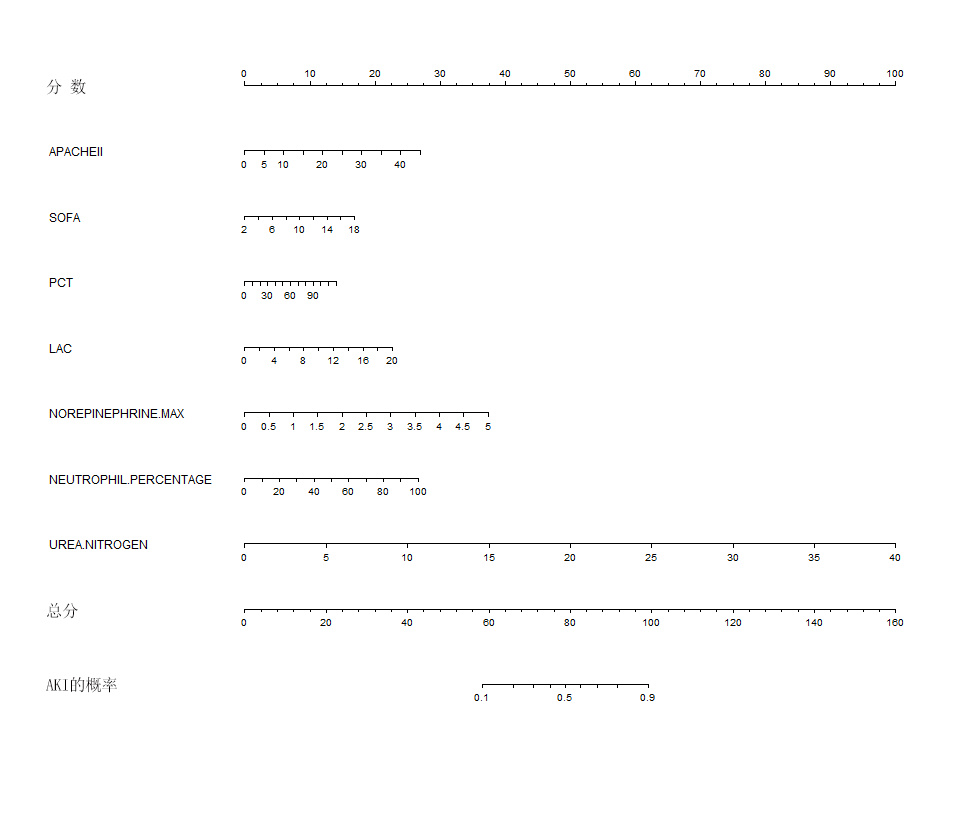
根据上述多因素Logistic回归分析结果构建列线图,见图 1。根据每一项指标,垂直画一条线到评分轴上,从而得到分值,最后将分值相加得到总分,总分向下的垂直线对应脓毒症患者发生AKI的概率,以便临床实践中评估入住ICU的脓毒症患者发生AKI的风险。
|
| APACHE Ⅱ为急性生理学和慢性健康状况评分Ⅱ,SOFA为序贯器官衰竭评分,PCT为降钙素原,LAC为血乳酸 图 1 预测ICU脓毒症患者发生AKI的列线图 Fig 1 The nomogram for predicting the occurrence of AKI in ICU patients with sepsis |
|
|
2.4列线图模型的评价和内部验证
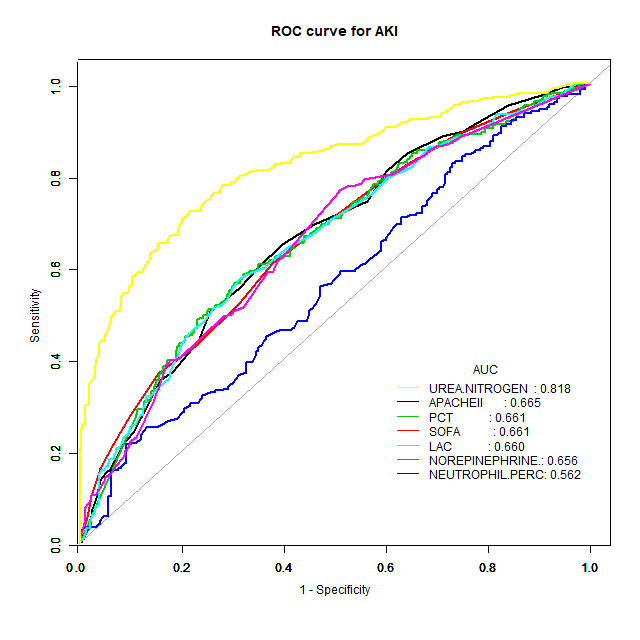
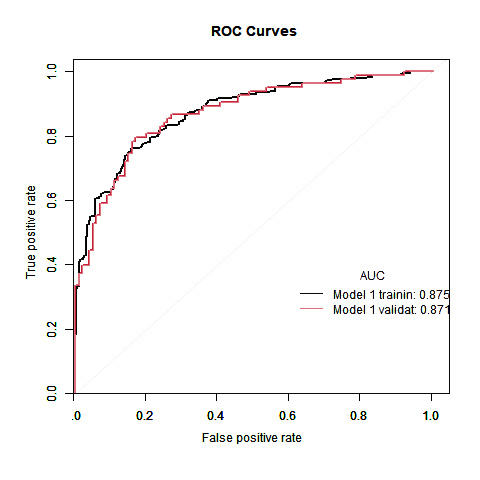
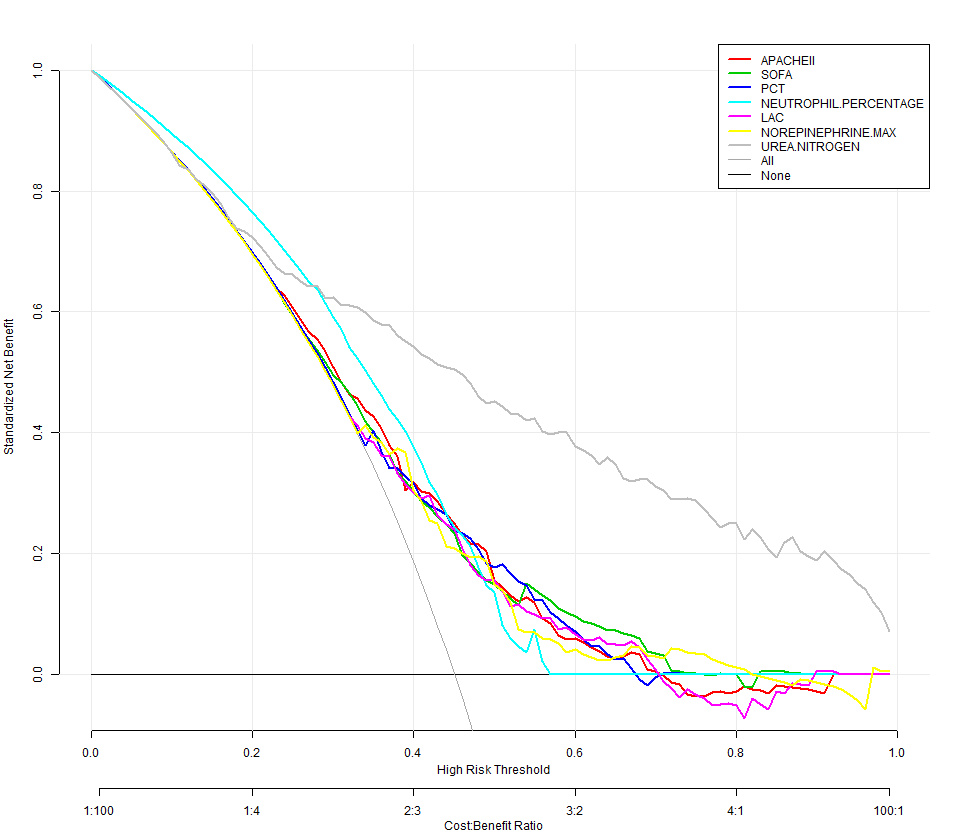
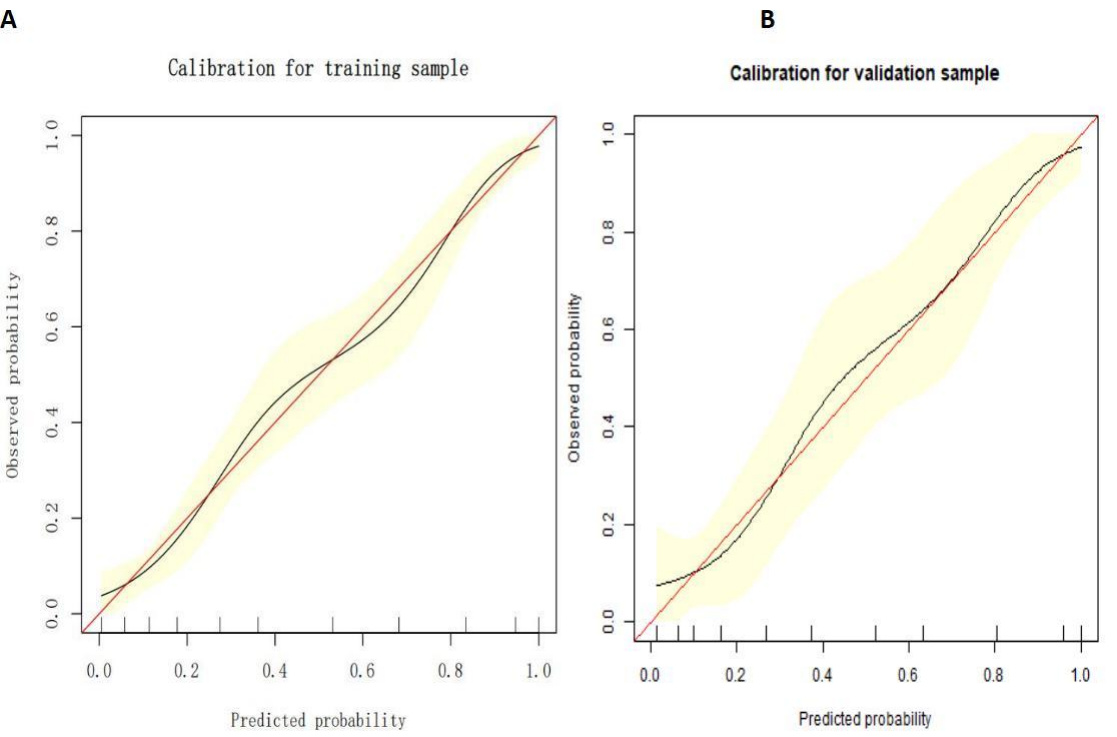
ROC曲线结果显示,各指标对AKI的预测结果良好,入室的血尿素氮表现出最高的预测AUC为0.818,见图 2。在训练集中,列线图表现出良好的区分度,AUC为0.875(95%CI:0.767~0.835),敏感度和特异度分别为0.741和0.853。将验证集中患者数据带入已构建的列线图,其对脓毒症发生AKI的预测AUC值为0.871(95%CI: 0.734~0.854),敏感度和特异度分别为0.708和0.864。见表 3、图 3。DCA的结果显示,相比单个指标,列线图模型在预测AKI的风险具有更好的临床净获益(图 4)。通过校准曲线可以看出,无论对于训练集还是验证集,列线图模型对ICU脓毒症的患者发生AKI的预测概率与实际概率均表现出良好的一致性(图 5)。
|
| APACHE Ⅱ为急性生理学和慢性健康状况评分Ⅱ,PCT为降钙素原,SOFA为序贯器官衰竭评分,LAC为血乳酸 图 2 预测脓毒症患者发生AKI的单个指标的ROC曲线 Fig 2 ROC curves of individual indicators for predicting AKI in sepsis patients |
|
|
| 因素 | 最佳 截断值 |
AUC | 95%CI | P值 | 特异度 | 敏感度 | 阳性预 测值 |
阴性预 测值 |
阳性 似然比 |
阴性 似然比 |
| APACHE Ⅱ评分 | 19.500 | 0.665 | 0.626~0.704 | < 0.001 | 0.604 | 0.650 | 1.642 | 0.580 | 1.642 | 0.580 |
| SOFA评分 | 8.500 | 0.661 | 0.622~0.700 | < 0.001 | 0.624 | 0.608 | 1.617 | 0.629 | 1.617 | 0.629 |
| 降钙素原 | 14.122 | 0.661 | 0.621~0.701 | < 0.001 | 0.679 | 0.583 | 1.818 | 0.614 | 1.818 | 0.614 |
| 血乳酸 | 3.050 | 0.660 | 0.621~0.700 | < 0.001 | 0.686 | 0.575 | 1.828 | 0.620 | 1.828 | 0.620 |
| 去甲肾上腺素用量 | 0.185 | 0.656 | 0.617~0.695 | < 0.001 | 0.491 | 0.767 | 1.507 | 0.475 | 1.507 | 0.475 |
| 血尿素氮 | 10.325 | 0.818 | 0.787~0.849 | < 0.001 | 0.785 | 0.720 | 3.351 | 0.357 | 3.351 | 0.357 |
| 中性粒细胞百分比 | 92.950 | 0.562 | 0.507~0.618 | 0.031 | 0.910 | 0.212 | 2.359 | 0.866 | 2.359 | 0.866 |
| 注:APACHE Ⅱ为急性生理学和慢性健康状况评分Ⅱ,SOFA为序贯器官衰竭评分 | ||||||||||
|
| 图 3 训练集和验证集的ROC曲线比较 Fig 3 Comparison of the ROC curves of the training and validation sets |
|
|
|
| APACHE Ⅱ为急性生理学和慢性健康状况评分Ⅱ,SOFA为序贯器官衰竭评分,PCT为降钙素原,LAC为血乳酸 图 4 预测脓毒症患者发生AKI的个指标的决策曲线分析(DCA曲线) Fig 4 Decision curve analysis (DCA curve) for individual indicators predicting AKI in patients with sepsis |
|
|
|
| A预测脓毒症患者发生AKI的训练集的校准曲线;B为预测脓毒症患者发生AKI的验证集的校准曲线 图 5 预测脓毒症患者发生AKI的训练集(A)与验证集(B)的校准曲线比较 Fig 5 Comparison of calibration curves for the training set (A) and the validation set (B) for predicting AKI in patients with sepsis |
|
|
脓毒症是AKI危险因素,因为肾脏对低灌注和一些干预措施(如机械通气和过度液体复苏)非常敏感。AKI的存在对脓毒症患者病死率的增加有显著影响,其范围从38.2%~70.2%[9-10]。Gómez等[11]发现40%~50%的脓毒症患者发生AKI,病死率增加6~8倍。此外,一项包括401名危重患者的前瞻性队列研究显示,严重脓毒症患者的AKI发生率为50.1%,是无脓毒症患者的7.79倍[12]。本研究显示,脓毒症患者AKI发生率为45.1%,与以上的研究结果基本一致。因此,开发和推广可靠的预测模型对于早期识别脓毒症患者发生AKI并为其提供及时有效的干预措施以改善其预后尤为迫切。
本研究通过单因素和多因素Logistic回归分析发现APACHE Ⅱ评分、SOFA评分、血LAC、PCT、NE使用剂量、尿素氮、中性粒细胞百分比等7项指标均为ICU脓毒症患者发生AKI的相关危险因素。因此联合以上7项指标构建了列线图预测模型,且列线图预测模型显示出良好的预测性能,其AUC值明显高于单一指标,因此更便于临床应用。在这些特征中尿素氮被认为是AKI最重要的指标,预测AKI发生的AUC值高于其他指标,这也与Yue等[13]使用机器学习对MIMIC- Ⅲ数据库中的脓毒症患者预测AKI的研究结果一致。李莫振等[14]研究显示,动脉血Lac、APACHE Ⅱ评分是脓毒症患者发生AKI的独立危险因素;陶丽丽等[15]研究显示入ICU时血乳酸水平具有预测脓毒症患者发生AKI和应用RRT的价值。PCT和中性粒细胞百分比为常见的感染指标,在脓毒症患者中都会显著升高。研究显示,PCT水平同脓毒症的AKI的发生以及预后相关,为AKI发生的独立危险因素[16-17]。脓毒症引起的免疫反应过度激活在发病过程中尤其重要,包括促炎和抗炎阶段。在促炎阶段,体液和细胞免疫可引起大量炎症因子,导致炎症因子过度分泌,补体和凝血系统激活,最终导致肾血流量减少,AKI和感染性休克的发生[5, 18]。而脓毒症休克的患者又需要血管活性药物维持机体循环功能的稳定[19],去甲肾上腺素是临床上最常用的血管活性药物,所以去甲肾上腺素的用量又提示病情的严重程度,会反过来影响AKI的发生。
本研究存在一定的局限性。首先,此研究是基于本医院近六年来单中心ICU数据库,没有进行外部验证,后续能有多中心的ICU数据库的患者将进一步去验证。其次,这是一项回顾性的研究,可能存在选择偏倚,今后将开展前瞻性的研究,去进一步优化完善模型。
综上所述,本研究基于入住ICU的脓毒症患者,建立了早期发生AKI的列线图模型,该模型具有良好的预测价值,辨别AKI的能力稳定,有助于临床医师识别ICU脓毒症患者发生AKI的风险,为脓毒症患者的并发症的预防提供有价值的信息。但该模型仍需在更多的人群中验证,并且AKI的影响因素仍需要进一步的探索,从而优化预测模型的变量。
利益冲突 所有作者声明无利益冲突
作者贡献声明 戎珊、胡庆河和郝翠平:研究设计、统计学分析、论文撰写和修改;叶久航、朱曼晨、钱彦春、张芬芬、李国海和朱丽娜负责数据收集及整理
| [1] | Hobson C, Ozrazgat-Baslanti T, Kuxhausen A, et al. Cost and mortality associated with postoperative acute kidney injury[J]. Ann Surg, 2015, 261(6): 1207-1214. DOI:10.1097/SLA.0000000000000732 |
| [2] | Hoste EAJ, Bagshaw SM, Bellomo R, et al. Epidemiology of acute kidney injury in critically ill patients: the multinational AKI-EPI study[J]. Intensive Care Med, 2015, 41(8): 1411-1423. DOI:10.1007/s00134-015-3934-7 |
| [3] | Pinheiro KHE, Azêdo FA, Areco KCN, et al. Risk factors and mortality in patients with sepsis, septic and non septic acute kidney injury in ICU[J]. Braz J Nephrol, 2019, 41(4): 462-471. DOI:10.1590/2175-8239-jbn-2018-0240 |
| [4] | Manrique-Caballero CL, Del Rio-Pertuz G, Gomez H. Sepsis-associated acute kidney injury[J]. Crit Care Clin, 2021, 37(2): 279-301. DOI:10.1016/j.ccc.2020.11.010 |
| [5] | Peerapornratana S, Manrique-Caballero CL, Gómez H, et al. Acute kidney injury from sepsis: current concepts, epidemiology, pathophysiology, prevention and treatment[J]. Kidney Int, 2019, 96(5): 1083-1099. DOI:10.1016/j.kint.2019.05.026 |
| [6] | Coelho S, Cabral G, Lopes JA, et al. Renal regeneration after acute kidney injury[J]. Nephrology, 2018, 23(9): 805-814. DOI:10.1111/nep.13256 |
| [7] | Singer M, Deutschman CS, Seymour CW, et al. The third international consensus definitions for sepsis and septic shock (Sepsis-3)[J]. JAMA, 2016, 315(8): 801-810. DOI:10.1001/jama.2016.0287 |
| [8] | Kellum JA, Lameire N, KDIGO AKI Guideline Work Group. Diagnosis, evaluation, and management of acute kidney injury: a KDIGO summary (Part 1)[J]. Crit Care, 2013, 17(1): 204. DOI:10.1186/cc11454 |
| [9] | Bellomo R, Kellum JA, Ronco C, et al. Acute kidney injury in sepsis[J]. Intensive Care Med, 2017, 43(6): 816-828. DOI:10.1007/s00134-017-4755-7 |
| [10] | Poston JT, Koyner JL. Sepsis associated acute kidney injury[J]. BMJ, 2019, 364: k4891. DOI:10.1136/bmj.k4891 |
| [11] | Gómez H, Kellum JA. Sepsis-induced acute kidney injury[J]. Curr Opin Crit Care, 2016, 22(6): 546-553. DOI:10.1097/MCC.0000000000000356 |
| [12] | Tejera D, Varela F, Acosta D, et al. Epidemiology of acute kidney injury and chronic kidney disease in the intensive care unit[J]. Rev Bras Ter Intensiva, 2017, 29(4): 444-452. DOI:10.5935/0103-507X.20170061 |
| [13] | Yue SR, Li SS, Huang XY, et al. Machine learning for the prediction of acute kidney injury in patients with sepsis[J]. J Transl Med, 2022, 20(1): 215. DOI:10.1186/s12967-022-03364-0 |
| [14] | 李莫振, 尉玉杰, 高静. 脓毒症患者并发急性肾损伤的风险预测列线图模型建立[J]. 安徽医学, 2021, 42(2): 179-182. DOI:10.3969/j.issn.1000-0399.2021.02.015 |
| [15] | 陶丽丽, 杨其霖, 陈维校. 入重症监护室时血乳酸水平对脓毒症患者急性肾损伤发生的预测价值[J]. 实用临床医药杂志, 2021, 25(14) 41-44, 53. DOI:10.7619/jcmp.20210726 |
| [16] | Hu QH, Zhang YQ, Xu HY, et al. Association between admission serum procalcitonin and the occurrence of acute kidney injury in patients with septic shock: a retrospective cohort study[J]. Sci Prog, 2021, 104(3): 368504211043768. DOI:10.1177/00368504211043768 |
| [17] | Jeeha R, Skinner DL, De Vasconcellos K, et al. Serum procalcitonin levels predict acute kidney injury in critically ill patients[J]. Nephrology, 2018, 23(12): 1090-1095. DOI:10.1111/nep.13174 |
| [18] | Opal SM, Ellis JL, Suri V, et al. Pharmacological sirt1 activation improves mortality and markedly alters transcriptional profiles that accompany experimental sepsis[J]. Shock, 2016, 45(4): 411-418. DOI:10.1097/shk.0000000000000528 |
| [19] | 何力, 苏连久, 张婧, 等. ICU内脓毒性休克急性肾损伤患者肾功能恢复的影响因素分析[J]. 中华危重病急救医学, 2020, 32(2): 199-203. DOI:10.3760/cma.j.cn121430-20200106-00037 |